

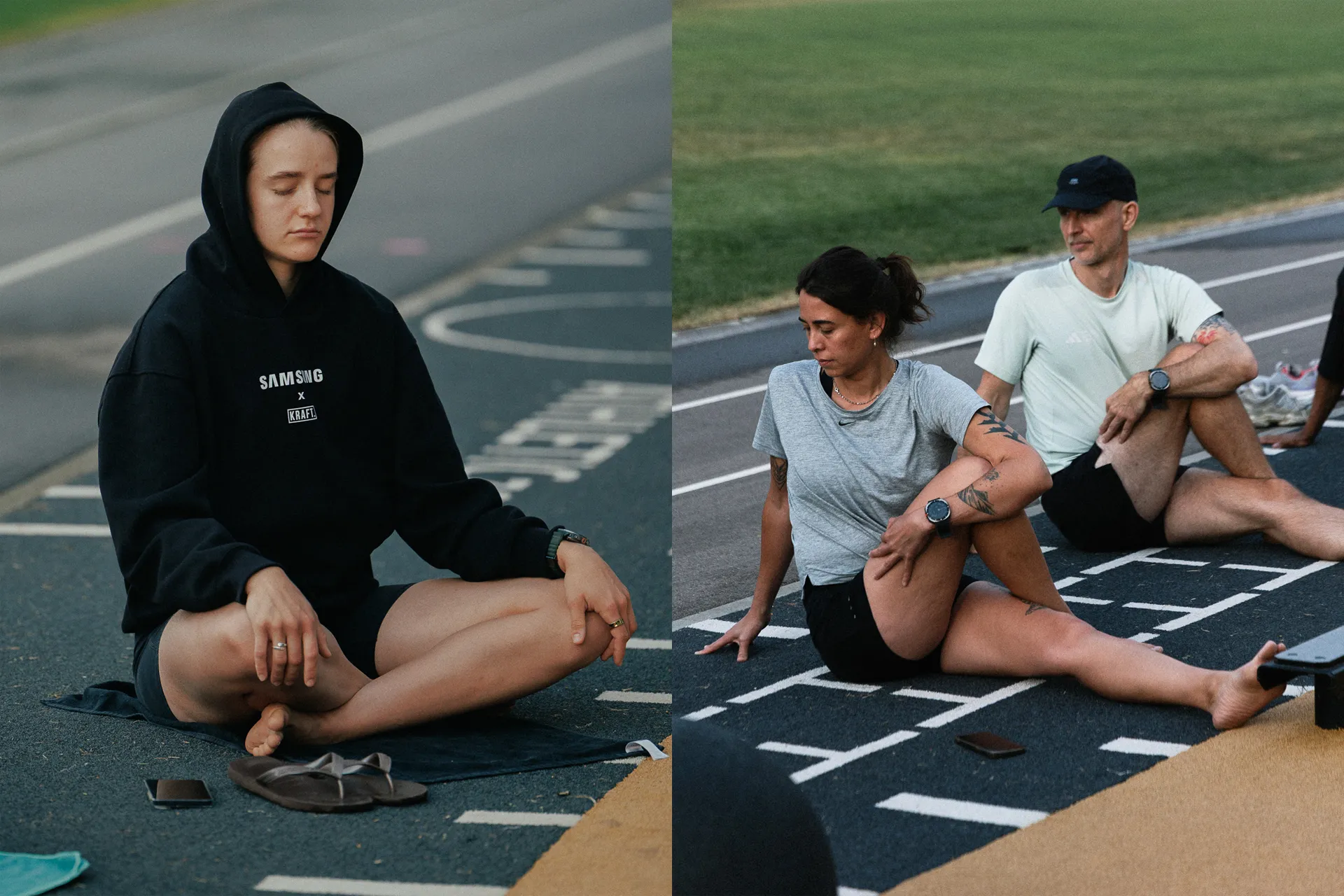
Three days of training camp in Freiburg and why recovery is part of training.
When training ends, an important part of the work begins
Saturday evening, just before seven. Our group already has three training sessions behind them. After the Wake me up Mobility session at seven in the morning, a twelve kilometre trail run with around 300 metres of elevation gain before noon, and an afternoon session focused on stability, strength, and plyometrics, the programme continued with beach volleyball or a visit to the outdoor pool.
Outside, it is slowly getting dark. The legs feel heavy, dinner has just finished. Now there is still a workshop on the schedule about what happens in the body when training stops. Pretty good timing for a session about recovery as a performance factor.
At the training camp in Freiburg, which KRAFT. and Samsung invited us to, the workshop focused on a simple but often underestimated idea. The training stimulus happens during exercise. Processing that stimulus takes considerably longer. Repair, replenishment of energy stores, and training related adaptation continue for hours and sometimes days afterwards. Sleep, sufficient energy intake, and sensible load management provide important conditions for these processes (4 to 6).
We believe this topic is so important and relevant that we wanted to share the essence of the workshops here.
Recovery is not a reward for training. It is the part of training in which adaptation can actually take place.
Training makes you tired first, adaptation takes time
A training session does not immediately improve performance. Directly after a demanding session, performance capacity is initially reduced. The body needs to replenish energy stores, process the structures that have been stressed, and respond to the training stimulus.
How long this takes depends strongly on the type of load. Intensity, training volume, mechanical demand, and training status all play a role, as do sleep, nutrition, and the demands of life outside sport (6).
That is why it is too simplistic to treat training and recovery as two separate things. Training provides the stimulus, while recovery creates the conditions that allow meaningful adaptation to develop from it. The whole process is a continuum.
Which recovery measures really matter?
From our perspective, it makes sense to prioritise recovery measures according to their practical relevance. This order is not the result of a single study. It is our practical interpretation based on three questions. How relevant is a factor for adaptation? How often is there room for improvement in everyday life? And how long lasting is the effect of a change?
For our work, this results in the following priorities.
Sleep and energy availability form the foundation. Next come load management and the demands of everyday life. Passive recovery measures such as cold exposure, massage, compression, or stretching come afterwards.
The individual areas have been studied to different degrees. This makes it especially important to distinguish between robust evidence and practical interpretation (1 to 8).
For our group, this order was hardly surprising. Much of it simply felt like common sense.
Sleep, unspectacular but incredibly important
Sleep was therefore one of the central topics of our workshops in Freiburg. It was even more encouraging to see that after such a long training weekend, everyone was still interested and engaged.
Many physically active people have room to improve their sleep. At the same time, sleep influences numerous processes that are relevant to performance and recovery.
A systematic review of sleep interventions in sport shows that both extending sleep duration and using targeted naps can have positive effects on different performance measures. In people who usually sleep around seven hours, the studies used sleep extensions in the region of roughly one hour or more. However, many of the studies were small and methodologically limited. These figures should therefore be understood as an approximate range rather than a precise recommendation (4).
More sleep is not a magical recovery hack. But if sleep is consistently too short, another evening massage is probably not the first thing to focus on.
Energy availability: recovery needs resources
Even the best training plan only works if the body has enough energy available.
Put simply, after meeting the demands of training, enough energy must remain available for other physiological functions. These include repair processes, immune function, hormonal regulation, and maintaining bone health.
Persistently low energy availability can be associated with a wide range of health and performance related problems. The International Olympic Committee brings these connections together under the concept of Relative Energy Deficiency in Sport, or REDs (5).
In practice, this means that training, nutrition, and recovery should not be viewed independently from one another.
Everyday life trains with you
Sport rarely takes place in a completely stress free vacuum. Professional demands, private conflicts, poor sleep, or a particularly busy week do not automatically disappear when training begins.
It was important for us to consider the wider context alongside the biology. Training load always affects a person who also has work, daily responsibilities, relationships, and other demands.
The physiological relationships are complex, so it would be too simplistic to equate training stress with life stress. One important practical observation remains. Stress from everyday life and stress from training affect the same person.
Someone who is currently carrying a lot of responsibility at work or in private life may have less capacity available for additional hard sessions. Good load management considers more than kilometres, weights, and intervals. It also considers the person doing the training.
Cold water works, but not always in the way you want
Cold based recovery strategies are among the most popular recovery methods. And they are certainly not ineffective.
Cold water immersion can reduce muscle soreness after demanding exercise (3). At the same time, systematic reviews and meta analyses show that regular immediate cold exposure after strength training can reduce certain long term adaptations to strength and hypertrophy training (1,2).
For endurance performance, the same meta analysis found no corresponding reduction in adaptation (1).
Timing also matters. In the studies examined, cold exposure was typically applied immediately after training.
So the key question is less whether an ice bath is good or bad. The more useful question is what the current training phase is trying to achieve.
When long term strength or muscle adaptations are the main goal, the current evidence argues against routinely using immediate cold exposure after every strength session. During competition phases, tightly scheduled training periods, or situations where short term recovery is prioritised, the decision may be different.
Recovery always has to be understood in the context of the individual. That was one of the central messages of the workshops.
Massage, stretching, and recovery boots: feeling better is not the same as adapting better
Massage is one of the recovery methods shown in research to reduce muscle soreness and subjective fatigue after exercise. In the meta analysis by Dupuy and colleagues, massage performed well compared with several other recovery strategies that were examined (3).
The same review did not find a comparable effect of stretching on muscle soreness (3). For foam rolling, the evidence included in the literature used here is not clear enough to make the same claim without an additional source.
So called recovery boots are also commonly used. For intermittent pneumatic compression of the lower limbs, a recent meta analysis found only negligible effects on functional performance recovery, while there were indications of an improvement in pressure pain threshold (8).
This highlights an important distinction in recovery. Feeling better after a recovery measure is a meaningful effect. But feeling more recovered does not automatically mean that long term training adaptation is stronger.
The training plan itself is a recovery measure
Passive recovery methods usually come after training. Training planning begins before it.
A well structured training week distributes high and low loads in a way that leaves enough time for recovery and adaptation. There is no universal number of hours that applies to every person and every session. Even so, typical ranges can be described.
Between demanding strength sessions that heavily stress the same muscle groups, at least around 48 hours of recovery are recommended. After maximal efforts, more time may be required. For high intensity sprint work, ranges of around 48 to 72 hours are often suggested. Individual variation is considerable (6).
Why some sessions have longer lasting effects than others
How long a training session continues to affect the body depends on several factors. These include intensity, volume, mechanical demand, and training status.
The involvement of the nervous system also matters. Maximal strength and sprint efforts place different demands on the body than submaximal sessions and may therefore require longer recovery (6).
Low intensity, predominantly aerobic exercise can often be repeated sooner. Context still matters. An easy run on flat terrain is not the same as several hours of trail running with long downhill sections. Fast eccentric loading in particular can have prolonged effects (6).
Why so much endurance training is easy
A large proportion of endurance training is performed at low intensity. That is not a sign of a lack of ambition.
In practice, many training models combine large volumes of low intensity work with a much smaller amount of hard training. Gabbett and Oetter describe a high proportion of low intensity training in endurance and cycling, with comparatively small proportions of high intensity work, often around 20 percent or less (6).
The underlying principle is understandable. Hard sessions provide strong training stimuli, but they generally require more recovery as well.
That is why a training week that is planned too densely cannot reliably be repaired afterwards with an ice bath, massage, or a roller.
Physiotherapy does not begin only when something hurts
This is where our role becomes especially relevant. Physiotherapy can involve much more than treating existing symptoms. In a training focused approach, the aim is to assess load capacity, identify relevant contributing factors, and structure training so that the next step fits the current situation.
At theroga.training, this process begins with a detailed initial consultation. Based on the history, appropriate assessments are selected. The result is not a rigid standard programme, but an individual assessment of current load capacity.
Return to Run and Return to Sport are guided by criteria rather than time alone. Structured load progression, individual training planning, performance testing, repeat testing, and monitoring all belong together.
The long term goal is not to make people permanently dependent on therapeutic support. Good education should help people assess their own response to load more effectively and increasingly manage their training independently.
What really matters after a training camp
One of our central aims was therefore to understand the training camp as a peak in overall load. Recovery does not end with the journey home. The days after the camp are especially important.
A training camp concentrates an unusually large number of training stimuli into just a few days. That is part of its value, but it also creates a genuine challenge.
The stimulus from those days should not be confused with fitness that is immediately available. The body needs time afterwards to process the load.
There is no universal, scientifically validated model for a specific week after a training camp. From our physiotherapy practice, we therefore recommend adapting the first few days to the individual response. This can mean easy activity or rest, enough sleep, adequate energy intake, and only increasing intensity again once the previous load appears to have been well tolerated.
Training hard again too early does not automatically cause an injury. But it can contribute to insufficient recovery and increase the likelihood that symptoms develop or existing irritation increases. The general principle of considering training load together with current tissue capacity is also part of modern models of running related injury development (7).
Sleep to Perform: why Sunday evening was all about sleep
By the second day, the group already had three sessions behind them: Mobility, Track, and Trail. Even so, everyone came together again for the second workshop in the evening. Under the title Sleep to Perform, we dedicated a full hour to sleep.
If sleep can make a meaningful contribution to recovery and performance, it deserves more than a brief mention between cold water immersion and foam rolling. After several days of concentrated training load, the connection between training, sleep, nutrition, and load management becomes particularly clear (4).
Perhaps the most important lesson from the training camp in Freiburg was simple. More recovery measures do not automatically mean better recovery. It often makes more sense to focus first on the biggest levers: the fundamentals.
Conclusion: recovery begins before the next break
Good recovery is not created by using as many tools as possible. What matters is planning training load and recovery together.
Sleep and sufficient energy availability form the foundation. Load management helps determine whether training demands match current capacity. Everyday life and psychosocial demands should also be taken into account. Massage, cold exposure, compression, and other strategies can all have a place, but their value depends on the goal and the context.
Physiotherapy can support exactly this interface by assessing load capacity, building training according to clear criteria, observing responses, and helping people understand their own bodies more effectively.
At theroga.training in Berlin Friedrichshain, this process begins with a detailed initial consultation and the assessments that follow from it. The focus is on structured load progression, Return to Run, Return to Sport, performance testing, repeat testing, and individual training management. Direct access is also available for self paying clients without a prescription.
What does good recovery mean to you: as many recovery tools as possible, or mainly a training plan that considers recovery from the beginning? Feel free to share this article via social media and let us know what you think. We look forward to your feedback.
Transparency note
The training camp in Freiburg was funded by Samsung. The invitation to the camp came from KRAFT and Samsung. This blog post itself is unpaid.
References
- Malta ES, Dutra YM, Broatch JR, Bishop DJ, Zagatto AM. The effects of regular cold-water immersion use on training-induced changes in strength and endurance performance: a systematic review with meta-analysis. Sports Med. 2021;51(1):161–174. doi:10.1007/s40279-020-01362-0
- Piñero A, Burke R, Augustin F, Mohan AE, DeJesus K, Sapuppo M, et al. Throwing cold water on muscle growth: a systematic review with meta-analysis of the effects of postexercise cold water immersion on resistance training-induced hypertrophy. Eur J Sport Sci. 2024;24(2):177–189. doi:10.1002/ejsc.12074
- Dupuy O, Douzi W, Theurot D, Bosquet L, Dugué B. An evidence-based approach for choosing post-exercise recovery techniques to reduce markers of muscle damage, soreness, fatigue, and inflammation: a systematic review with meta-analysis. Front Physiol. 2018;9:403. doi:10.3389/fphys.2018.00403
- Bonnar D, Bartel K, Kakoschke N, Lang C. Sleep interventions designed to improve athletic performance and recovery: a systematic review of current approaches. Sports Med. 2018;48(3):683–703. doi:10.1007/s40279-017-0832-x
- Mountjoy M, Ackerman KE, Bailey DM, Burke LM, Constantini N, Hackney AC, et al. 2023 International Olympic Committee’s (IOC) consensus statement on Relative Energy Deficiency in Sport (REDs). Br J Sports Med. 2023;57(17):1073–1097. doi:10.1136/bjsports-2023-106994
- Gabbett TJ, Oetter E. From tissue to system: what constitutes an appropriate response to loading? Sports Med. 2025;55(1):17–35. doi:10.1007/s40279-024-02126-w
- Bertelsen ML, Hulme A, Petersen J, Brund RK, Sørensen H, Finch CF, et al. A framework for the etiology of running-related injuries. Scand J Med Sci Sports. 2017;27(11):1170–1180. doi:10.1111/sms.12883
- Maia F, Nakamura FY, Sarmento H, Marcelino R, Ribeiro J. Effects of lower-limb intermittent pneumatic compression on sports recovery: a systematic review and meta-analysis. Biol Sport. 2024;41(4):263–275. doi:10.5114/biolsport.2024.133665